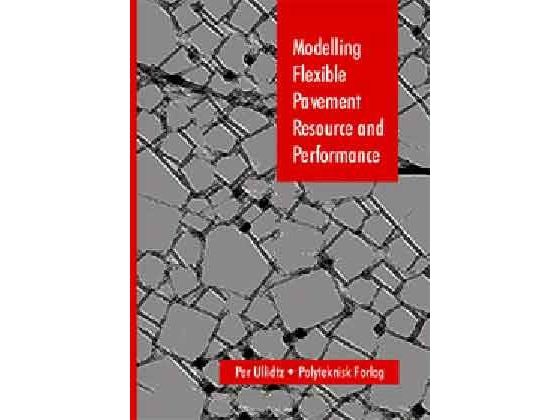
Textbook concerned with models for predicting the future condition of flexible pavements, as a function of traffic loading, climate, materials, etc., using analytical-empirical methods. With references and index. Content 1 Introduction 2 Theory of elasticity 2.1 Elastic parameters 2.2 Stresses and Strains in a continuum 3 Assumptions of the theory of elasticity versus reality 3.1 Stress concentration 3.2 Anisotropy 3.3 Shear sensitivity 3.4 Probabilistic stress distribution 4 Odemark’s method 4.1 Example of the Use of Odemark’s Method 4.2 Westergaard’s equations for rigid pavements5 The Finite Element Method (FEM) 6 Non-linear models 7 Viscous and visco-elastic modes (Rheology) 7.1 Kelvin model 7.2 Maxwell model 7.3 Burgers model 7.4 Parabolic element 7.5 The SHRP model 7.6 Temperature shift factor 8 Distinct Element Method 8.1 Two dimensional stress distribution 8.2 Biaxial tests on angular elements 9 Structural damage prediction 9.1 Example of HDM III model 9.2 Deflection is a poor substitute for bearing capacity 9.3 Asphalt strain criteria 9.4 Continuum Damage Mechanics 9.4.1 Damage based on Actual Stress 9.4.2 Damage based on Energy Density 9.4.3 Damage based on Delayed Elastic Energy Density 9.5 Finite Element simulation of asphalt damage 9.6 Visible cracks in asphalt pavements 9.7 Cracking of Portland Cement bound materials 10 Plastic deformation11 Roughness 11.1 The AASHTO design equation for flexible pavements 11.2 Mathematical Model of Pavement Performance (MMOPP) 11.2.1 Spatial variation of pavement parameters 11.2.2 Climatic variations 11.2.3 Loading 12 Determination of Moduli 12.1 Laboratory tests and equations based on standard tests 12.2 In Situ tests 12.2.1 Wave propagation methods 12.2.2 Falling Weight Deflectometer 12.3 Design values13 Verification of response and performance models 13.1 Verifying response models 13.2 Verifying performance models 13.3 Verification using a PMS (PERS) 14 Surfacing characteristics 14.1 Skid resistance 14.2 Ageing 14.3 Surface wear15 Uniform subsections16 User effects 16.1 Vehicle operating costs 16.2 Accident costs 16.3 Other effects 17 Optimisation18 ConclusionReferences Index
Produktet har følgende varenummer i vårt system:
SKU:
9788750208051
EAN:
9788750208051
Hvorfor ser jeg at det samme produktet er tilgjengelig på forskjellige varenumre?
Produsenter lanserer ofte det samme produktet med forskjellige varenumre, vanligvis bare forskjellige versjoner av emballasjen. For eksempel kan emballasjen være rettet mot forskjellige land.
Vi gjør vårt beste for å forene produktene, men det kan skje at det samme produktet vises på forskjellige varenumre i systemet vårt.